Back to School
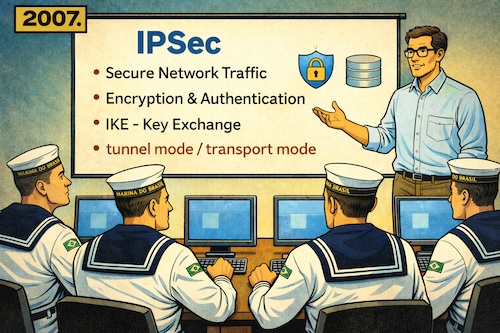
While we were working on the consulting projects at Brasil Telecom, my friend Pagliusi, whom I’ve already mentioned, got in touch and invited me to teach training sessions on some information security topics for the Navy. Even though I wasn’t formally employed by the company (I worked as a contractor), I thought it was a good idea to talk to my boss, who was one of the company’s partners, before confirming that I could teach the courses. My idea was that those training sessions would be the first piece of work I would bring to the company. Still, I had been invited directly, and it seemed obvious to me that the Navy’s intention was to hire me as the instructor.
Right at the start, though, my boss took over the negotiations and ended up arranging things so that I would be the instructor for one of the courses and he would handle the other. Over time, I realized that wasn’t an isolated case: there was a clear pattern in which the partners kept for themselves anything that would bring some kind of visibility, leaving the grunt work to the other employees.
Once the deal was closed, it was time to prepare the course. My session was a training course on IPSec, the protocol that enables secure communications over IP networks. I imagined something very hands-on: the students would set up IPSec on virtual machines and then observe the communications between those machines using Wireshark, which was then still known as Ethereal. I ran some tests at home, prepared the configuration instructions, and then went back over the theoretical concepts behind the protocol, since the course also required a conceptual part.
Even though the training had officially become a company project, I ended up using a good chunk of my weekends preparing the materials. There was, of course, some excitement about being able to teach a course very close to my area of expertise, cryptography, but it also weighed on me that the company didn’t give me time during the workweek for this kind of preparation.
On the day of the training, when I arrived at the classroom at the Navy facilities, I started getting the environment ready. And then came the typical problems of hands-on classes: some virtual machines showed the famous “blue screen of death” when Wireshark was installed. After a while, we worked around the problems and the hands-on part ended up working. From my perspective, the training was a success. The fact that the Navy never got in touch again about new courses may indicate that, since the partner ended up getting involved and changing some of the parameters that had initially been requested, their evaluation may not have been that positive.
This period of consulting at Brasil Telecom also coincided with a time when both Gisele and I started getting involved with private universities in Brasília. We ended up being invited to teach, mainly in graduate courses. I had already had some experience as a professor at that level during my time living in Campinas: there was a school with offices near the Rio Stock Exchange that paid for my trip from Campinas to teach classes in a security program.
In Brasília, I was invited by a university to teach the computer networks course in a graduate program in information security. It was all pretty last-minute: they called me only a week before classes started, because the previous professor had dropped out. The course coordinator struck a deal with that professor so that I would teach the classes under his name, and he would pass the salary along to me. I said upfront that, with such little time, I wouldn’t be able to prepare elaborate slides and that I would mostly teach using the whiteboard. Some students complained about the lack of course material, but I made it clear there wasn’t time to produce it. I shared my notes and asked them to follow along and take notes on the content discussed in class. In the end, it wasn’t as bad as it could have been.
A conscious decision I made in that course was to avoid tests. I’ve always thought tests are bad for students and too much work for the teacher. I opted to base the grading on assignments and in-class presentations. Since the course was short, the grade would be based mainly on a final project, with two parts: a written report and a presentation to the class. From my point of view, a careful choice of topics would help complement the classes. For the students, writing reports and giving presentations seemed to me an essential skill for qualified professionals.
The groups presented their projects at the end of the semester and handed in the written reports. I was honestly surprised by the quality of many of them. Surprised, but also suspicious. In some cases, the level was way above what I’d expected. One of the papers, for example, had a long bibliography section with references to prestigious international journals. I thought it was strange for the student to have access to that material, since the university didn’t have a particularly good library.
I decided to investigate using Google. I copied the first sentence of the paper and found exactly the same text, bibliography and all, published on the internet. If one paper had been copied, odds were others had too. I searched for the first sentence of every paper. The success rate was 100%. In one case, the student had merged excerpts from two different articles, both copied word for word. The result even kind of made sense, but it was still plagiarism.
I took the problem to the course coordinator. From my point of view, all those papers should receive a zero, plus some formal sanction. I thought it was important to make it clear that copying third-party text wasn’t acceptable. The coordinator was very busy and hard to reach. I sent an email explaining the situation and left the papers at the university office.
Next came the part where I had to get paid for the work I had done. Since I was officially just substituting for another professor, the payment had been made to him. I got in touch with the coordinator to resolve the issue. It wasn’t easy: the negotiations were stressful, but, with more than a month’s delay, I eventually received what I was owed.
After all that mess, I gave up teaching at that university. I didn’t give up, however, on the idea of teaching in graduate programs. Some time later, I was hired by another university, now with a formal employment contract. The institution paid a very low monthly amount to officially keep qualified teachers on its payroll and paid well for actual classroom hours. Many private universities adopt this model in order to list professors with master’s degrees and PhDs on their payroll, which improves their evaluations by regulatory bodies. In this second case, the classes went much more smoothly, we reached the end of the semester without major issues, and this time I got paid on time.
At the start of the following semester, the university decided to make a change in its faculty roster and let me know my contract would be terminated. For me, that was not a problem: I had no obligations beyond the classes I’d already taught. A few days later, however, I got a letter summoning me to appear at the Labor Court for the termination of the contract. I didn’t really understand how that worked and found it especially inconvenient to have to interrupt my workday to attend the hearing.
I went anyway, but arrived a few minutes late. When I walked into the room, I was told the decision had already been made by default, that is, without considering my position. I didn’t want anything other than to get my “carteira de trabalho” back (Brazil has a specific, passport-like employment record book that companies use to record a person’s work contracts). Because of that mess, I was without my employment record book for more than a month and had to deal with a good deal of bureaucracy to get it back.
Eventually, the time came to make a switch: instead of teaching, I decided to go back to being a student to prepare for some of the national civil service exams, but that’s a story for another chapter.