Commodore 64
In 1985, my brother and I went to live with our father in Rio, right in the middle of the market reserve era. For those who don’t remember, or didn’t live through it, the market reserve was a policy that restricted imports of computers and parts into Brazil. The result was the emergence of a whole generation of local clones: the TK85, MSX, CP-500… Machines that copied foreign architectures and ran software that was either copied, adapted, or simply identical to the originals.
Despite the restrictions, my father managed to buy a Commodore 64: one of the most successful personal computers of its era. His was an original, smuggled in by some acquaintance, and it had, besides the CPU, a floppy disk drive. Almost nobody had that. Most people still used cassette tapes to store programs, and anyone who has dealt with those knows the pain of rewinding the whole tape to get to the right spot. The floppy disk, besides being digital, allowed direct access to any file in seconds.
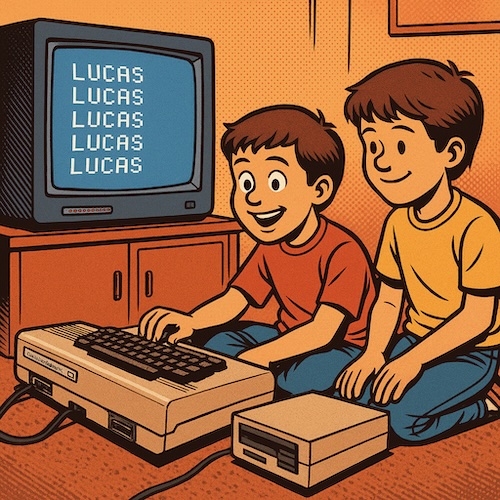
It was love at first sight. My brother and I spent hours tinkering with that computer, trying to figure out how it all worked. We bought a few little books on BASIC, which was the Commodore’s default language, and started writing our first programs. The first one, of course, was the classic “name-in-a-loop”:
10 PRINT "LUCAS"
20 GOTO 10
Simple, but magical. Watching your own name appear over and over on the screen was like watching the computer “talk” to us for the first time.
The Commodore was the first computer we had at home — and BASIC, our first programming language. We spent entire afternoons and holidays reading, experimenting, making mistakes, and trying to understand what each command did. That was where, without us realizing it, the taste for programming and computing was born.
But the Commodore wasn’t only BASIC. It had its own ecosystem, with plenty of games and programs, though in Brazil it was hard to find. Since there were no national clones, there was also no local circulation of compatible software. We eventually discovered a few newsstands that sold imported magazines dedicated to the Commodore 64. Those magazines were real treasures: besides articles and tips, they came with pages and pages of printed code, entire programs written in machine language, listed line by line.
The computer, of course, didn’t read magazines. So what did we do? We typed everything in. We spent whole days transcribing that code, one dictating and the other typing. After hours of work, the result didn’t always pay off: sometimes the program was bad, or it simply didn’t work. But the feeling of seeing something run after so much effort was indescribable. And, just in case, we saved everything to a floppy — nobody wanted to type that all over again.
We got so obsessed with the Commodore that my father eventually gave up on it and said: “Take it with you, you use it more than I do.” When we went back to living with our mother, the computer came along. It didn’t have its own monitor, so we’d hook it up to the living-room TV and spend hours programming, playing, or just exploring the unknown. Over time, the old Commodore started to act up. Fixing it was expensive and complicated. We found a little shop that could service it, but every six months the thing was back in there. Until one day we understood: our first computer was reaching the end of its useful life.
That’s when we started to think: now what? What’s our next computer going to be?