TK 3000
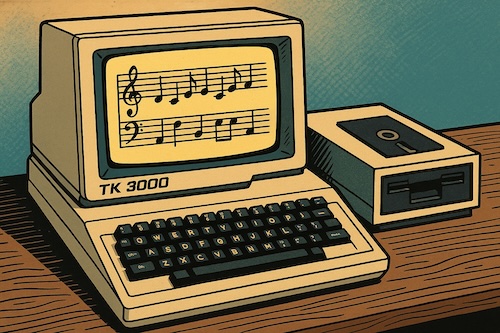
After the Commodore, our next computer was the Brazilian TK 3000, which I got as a birthday present. My 15th birthday was coming up and my grandmother asked if I’d like a trip to Disney World in Florida (the dream of the vast majority of Brazilian teenagers back then), but I answered that I wanted a computer.
My brother and I did some research and concluded that the best option was the TK 3000, a clone of the Apple IIe. With it, we left the Commodore world behind and entered the Apple universe, which came with a big advantage in Brazil at the time: a lot of people used Apple clones, and some even had the real thing. That meant there was plenty of software going around — maybe not as much as for the MSX, but enough to make the Apple platform an interesting choice. The computer was also expandable, which made it even more appealing: you could open up the machine and plug in new little boards, something that would become common in PCs years later.
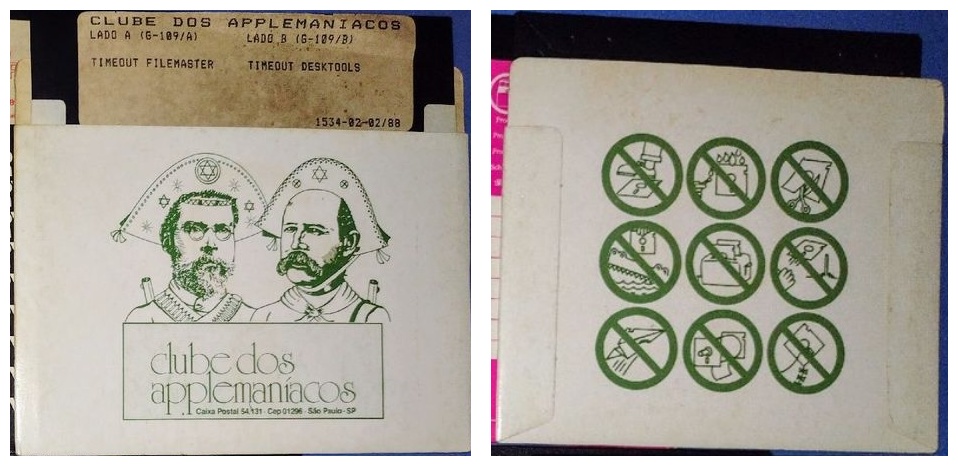
With the new computer, we had to start our software collection over, since nothing from the Commodore worked on it. The TK also used floppies, still the big 5¼-inch kind. It was during this search for new games and utilities that we discovered a piracy network called the Clube dos Applemaníacos (the “Apple Maniacs Club”). The club let its members trade programs: you’d just send a floppy with something they didn’t have, and in exchange they’d send you two others from their library. Since we had nothing to offer at first, we started by buying a few programs from their collection. They shipped everything by mail, straight from São Paulo to Belo Horizonte.
The most fun part was the little floppy sleeves, which came with unconventional instructions. Instead of warnings like “do not fold” or “keep away from magnets,” the Applemaníacos sleeves said things like “do not feed the disk to the alligator” or “do not put it in the toaster.” A kind of silly humor that was highly appealing to two teenage boys.
In time, the club made our lives much easier. Our software library grew, and we started to meet other friends who also had Apple-compatible computers. Since we only had one drive, copying floppies was a challenge. That’s how we discovered programs specialized in making copies, probably obtained from the Applemaníacos library itself. The software could copy almost anything — only a few copy-protected disks resisted cloning.
While copying, the program displayed details about what was on the floppies, and that’s when we started learning about tracks, sectors, and blocks. That was how data was physically stored, and understanding that opened the door to another kind of curiosity: how information is actually structured. We learned about binary, hexadecimal, and other details of how computers work.
The next step was discovering sector editors. These programs let you manually read and modify the content of each sector on a floppy. At first, we didn’t really know what to use that for, but it did show us a kind of program we didn’t even dream existed.
One of the most striking differences between the Apple and the Commodore — and one of the ones that bothered us the most at the time — was the sound. The Commodore had a dedicated sound chip and used the TV’s audio, while the Apple only had a tiny speaker with muffled, metallic sound. But the Apple had an advantage: it was easy to expand. You just bought an extra board and plugged it in. We kept adding video memory, graphics upgrades and, of course, a decent sound card. We got to a point where the sound no longer came out of the TV, but from the home stereo. Another level, another quality.
I remember a program that let you write musical notes and play them back on the stereo in the living room. You’d hook up the joystick, write the melody on the sheet, and the computer would play the song. Watching that work was almost magical.
Over time, the Apple started to age, and PCs began to dominate the market. So it was time to switch…