Senior Stapler Operator
My high school program was a technical degree in electronics. There wasn’t much computing in the curriculum — the closest thing was digital electronics, and even that boiled down to designing and assembling logic circuits with AND, OR, XOR gates and the like. When I finished the course, an internship was mandatory, so my classmates and I started looking for openings. We took tests at several companies and then just waited for the results. The most coveted internship, not just at my school but in the whole city, was the one at IBM, in computer maintenance. And back then, maintenance meant dealing with mainframes.
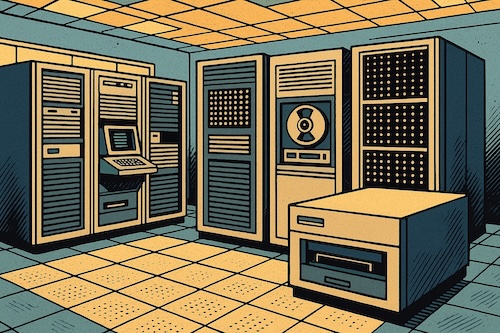
I passed the test and, at 17 years old, off I went in a tie and badge to start as a maintenance technician. I learned a lot about hardware, and it was fascinating to step out of the world of PCs and into the world of mainframes. At the same time, it was like taking a trip back in time: much of the equipment still in use dated from the 1970s or even the ’60s, true relics. Up close, I saw reel-to-reel tape readers (just like in the movies, with reels spinning and lights blinking), printers that ran on oil, and power supplies that looked more like generators. Some systems even required water cooling, something unimaginable to me at that moment. Some models still used pre-integrated-circuit technologies (ferrite core memory, circuits with transistors, resistors, and other analog components…).
Beyond the technical learning, there was something even more impressive: IBM’s internal network. It was a worldwide private network of its own, connecting offices and mainframes in every country where the company operated. It wasn’t the internet, but it worked like a corporate version of it, and in the early ’90s that was straight out of science fiction. It was my first contact with a global computer network. We could send “notes” (what today we would call emails) and even participate in internal discussion forums. Of course, in a technology company, those forums were full of conversations about systems, languages, and antiviruses. And that’s where my interest in computer viruses, which had been there for a while, found fertile ground.
Little by little, I began reading and taking part in discussions with specialists from around the world. I discovered IBM had researchers in Yorktown Heights, New York, dedicated exclusively to studying viruses. They exchanged ideas and published analyses, and there I was, a 17-year-old Brazilian intern, following it all. Sometimes I’d even ask questions, or ask for tips about antiviruses or technical details. I confess I spent more time exploring the internal network than my boss probably would have liked. Back then, virus analysis was still manual, done one at a time, and more art than science. Thanks to that connection, I had access to experimental tools coming straight from IBM’s labs, and also easy access to antivirus updates. It was a learning experience that broadened my horizons.
Over time, my boss noticed my interest was more in networks and software than in maintenance as such. And then a new opportunity came up. Outside the maintenance area, there was the data center planning group, and the person in charge was drowning in work. They put me in to help. One of the tasks was doing the physical design of the data center: cutting out to-scale pieces of plastic representing the equipment models — enormous metal cabinets — and finding an arrangement that would fit the floor plan. It felt like an architect’s job.
But the other part was even more exciting. At that time, IBM was starting to roll out a new networking technology in Brazil called Token Ring. My new boss was the one responsible for studying the technology and putting together the first projects in Belo Horizonte, and he ended up giving me access to the same online course he was taking. I learned a lot about how Token Ring networks worked and how they compared to other technologies, like Ethernet, which would later become dominant. It was quite an opportunity to understand computer networks: how they communicate, how they distribute data, and how they can be planned. I still think Token Ring was a brilliant technology, and the only reason it didn’t take off was that IBM kept a monopoly on the equipment, which made it expensive and hard to come by.
Around the same time, the first IBM RISC computers started arriving in Brazil. We didn’t have much contact with them, but just seeing them running sparked curiosity. Years later I would come back to study that technology with a different eye, but that was my first glimpse of a new chapter of computing.
Oh, and about the title of this chapter: it was an inside joke among the technicians. They used to say that interns’ functions were things like “Senior Stapler Operator,” “Xerox Copier Specialist in Training,” and other equally glorious titles. We’d laugh, pick up the tool case, and off we went, alongside the technicians, to solve the problem of yet another customer with a broken computer.