A Network for the University
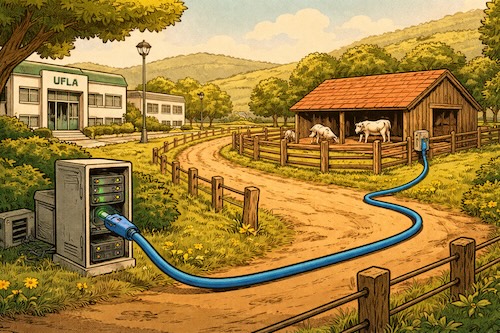
Over time, other professors joined UFLA, including those hired to teach computer network topics. With that, the university now had people who could start looking after the computing infrastructure it wanted to modernize. At the time, there was only a single connection to the state research network (which served as the connection to the rest of the internet), concentrated in the main administrative building. Anyone who wanted to access the internet needed to use a modem and dial into one of the phone extensions of a kind of BBS set up there. It was also possible, at least for professors, to dial in from outside the university or from home. Even by the standards of the time, that network could already be considered pretty outdated.
Little by little, we started finding out what plans had been made before we arrived. One of our colleagues found documentation for a project designed in partnership with IBM to build a fiber-optic network across the whole campus, with state-of-the-art infrastructure provided by IBM itself. From what we were told, the company had even promised to handle getting the funding approved by the Ministry of Education. In other words, the university would only need to sign the agreement, and IBM would take care of everything else, including the lobbying.
But real life doesn’t work that way. IBM began to show signs that it was having serious difficulties getting the funding approved as it had promised. That meant the university wouldn’t have the resources to build that “dream” network. The funny thing is that IBM was so confident that it started working even before the funds were approved. When we went to look more closely, we found that practically all of the fiber-optic infrastructure had already been run across the campus. Very little was missing, generally in less important places. Because it was a rural university, the campus included plantations, animal facilities, and similar areas that were part of the original network project, but where the fiber hadn’t yet reached. We quickly concluded it didn’t make sense to run fiber out to the cattle corral, for example, and realized that, for academic purposes, the university already had practically all the fiber cabling infrastructure it needed.
So the first step had already been taken: the network cabling was in place. In conversations with the university administrators, though, it wasn’t clear whether that fiber could be used freely or whether it was IBM’s exclusive property under the original project. One of the new professors, Luiz Henrique, took the lead on this question, negotiated with the administration, and got authorization to use the existing infrastructure to build the campus network. The idea was to get funding to buy a few switches and interconnect the various buildings (starting with ours, of course) with the main administrative building, which already had internet access. Little by little, the equipment was purchased and the buildings connected one by one. Within each building, internal infrastructure also had to be put in place, which happened as funds became available. In the end, we managed to build a network connecting the whole campus, at a much lower cost than the megalomaniacal project originally proposed by IBM.
Since we kept in contact with IBM, we learned of a call for proposals it had launched to support research. You had to submit a project, and the selected research groups would receive IBM equipment for their research. Since, at the time, I was working on electronic payment systems and had just published a paper on pay-per-use, I submitted a project along those lines and was selected. Through that project, I received an IBM RS/6000 workstation, which ran the company’s UNIX, AIX. That machine became my day-to-day computer, since the equipment available at the university was a bit old. It was a good workstation and allowed me to learn a bit about AIX and develop a few things in Java.
I later heard rumors that those responsible for the UFLA project at IBM had been fired, but I never knew whether that was true. Meanwhile, classes continued and the semesters went by, but that’s a story for the next chapter.