Don’t Get Cocky
At the same time we were starting to put the program together at UFLA, it became clear that, since it was still in its early days, it didn’t need that many full-time professors. Many of the faculty hired at the time were still finishing their PhDs, or had not yet started. I finished my master’s while already teaching at UFLA and began to think about my next steps. Those of us already teaching at UFLA got together and organized a schedule so that everyone could do their PhD, something indispensable for progression in an academic career. With just an undergraduate degree or a master’s, the salary was very low; only with a PhD did it become at least reasonable, but still far from high.
At that point, I got lucky because Montserrat, with whom I shared the courses, had already finished his PhD, so he didn’t compete with me for a slot in that schedule. On top of that, since our courses were quite introductory, anyone could act as a substitute. So it was decided that I could leave for the PhD after two years at UFLA (around mid-1999). When I finished the master’s, I started looking at alternatives for the PhD. What I really wanted was to do it abroad, taking the opportunity to bring my family to live outside Brazil for a while.
I picked about six top international universities that had research in security or cryptography and started the application process for all of them. Doing that from Brazil was complex and laborious, because many of them required paper forms and fee payments in dollars. I often had to send postal money orders because it was the only form of payment I had access to that the universities accepted. Luckily, by then the application instructions were already available online, and it was also possible to get help by email. The biggest problem was that I had to secure, at the same time, acceptance into a university and a scholarship. UFLA did not have PhD scholarships available for computing professors that year, so I’d have to get funding from an external source.
Getting a scholarship in the United States, as an international student, was practically impossible. The only support UFLA could provide me with at that moment was paid leave, but the salary was too low to survive in the US. On top of that, the universities required tuition payments. Without a scholarship, there was simply no way. So I started applying to calls for applications from both CAPES and CNPq, the two main sources of public funding for PhD studies in Brazil.
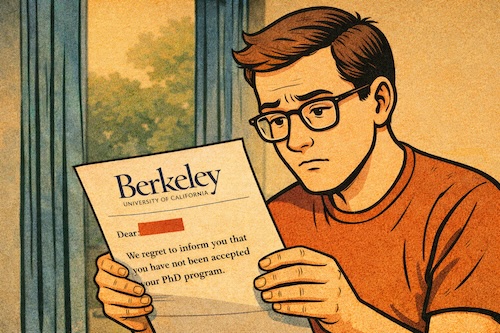
It turned into the classic chicken-and-egg problem: the university wanted proof that I had funding before offering me a spot, and the funding agencies wanted proof that I had been accepted by a university before granting a scholarship. Even so, I filed the applications and decided to see what happened. I got to the final stages of the CNPq selection process, missing only formal acceptance from a university, but that didn’t come. Gradually, rejection letters started arriving from every university I had applied to.
Since the dream of doing a PhD abroad went up in smoke, we started thinking about alternatives. Gisele didn’t want to stay in Lavras: there weren’t many career possibilities for her there. So we decided we would both apply to Unicamp’s graduate program. In my case, admission was practically guaranteed: as a former student, I had already talked to my advisor, and all I had to do was send the paperwork. For her, the process involved more uncertainty, but her degree was solid and we believed it would work out.
And it did. We were both accepted: she in the master’s and I in the PhD. The next adventure, then, would be to leave Lavras and head to Campinas.
Looking back at this attempt at a PhD abroad, I think I made some mistakes that made everything harder, both in the university applications and in the search for a scholarship. Maybe the biggest one was too much self-confidence. I had graduated from top universities in Brazil, had ranked at the top of my class at both the undergraduate and master’s levels, and had come in first in a federal university faculty selection process. I imagined it would be obvious that some PhD program would accept me. Life, of course, doesn’t work that way. A bit more humility would probably have helped.
Today it’s clear I was surrounded by very qualified people who could have helped me: my advisor, colleagues at UFLA (many of them already with PhDs), and even my mother, who was a professor and had a PhD (see this chapter). Even so, I decided to do it all on my own. Well, that’s how you learn.