The First PC
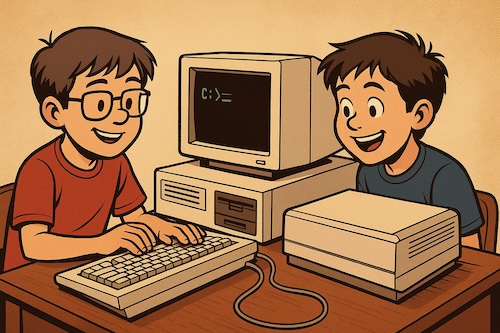
After the Apple — or rather, the TK 3000 — we went all the way into the PC universe (formally, the IBM PC). By then, the PC already dominated the market not only in companies but also in homes. Whoever had a computer, generally had a PC. Ours was a full setup with the brand-new Intel 286 CPU, a color VGA monitor (cutting edge at the time), a printer, and everything else. It was starting to feel like something more serious, almost professional. And there was a big advantage to this new phase: standardization. Since everyone was migrating from MSX and TK machines to the PC, it was much easier to exchange data and software and to take part in the informal trading network (or rather, the piracy scene) that dominated Brazil in that period.
I was still a teenager. Copying programs was what everyone did without giving it a second thought, so we did it too. Swapping a floppy with a new program or a little game was as common as snipping a notch out of the side of a floppy to turn it from single-sided into double-sided. That’s how we ended up with access to a huge amount of software.
Our PC ran the DOS operating system. We tried both Microsoft’s MS-DOS and IBM’s PC-DOS, and the story behind that is an interesting one. When IBM designed the PC and commissioned DOS from Microsoft, it let the company also sell its own version of the system. The differences between the two were minimal: from a user’s point of view, they were practically identical. We learned a lot by playing on the command line, copying files and exploring the system. DOS was necessary in order to run Windows, which at the time was just a graphical interface layered on top of the system. It would still be a few years before Windows became a full operating system that didn’t rely on booting through DOS first.
With the PC, we also discovered Turbo Pascal, the most popular IDE of its time for the Pascal language. It was with Turbo Pascal that we started to program in a more structured and modern way than we had in BASIC. Pascal was widely used in universities, and many intro-to-programming courses revolved around this language. Including mine, a little later.
Since the PC became the standard, swapping floppies became routine. You’d send a program here, copy a little game there… and that’s how we met our first computer viruses. It was an almost folkloric novelty: each virus had a name, and everyone knew which ones we were talking about. I remember Cascade, which made the letters fall down the screen until they piled up at the bottom, and others with creative, sometimes scary names.
Soon after came the antivirus programs. We started using tools like McAfee, F-Prot, and Norton Antivirus, still in a time when having the internet at home was the exception, and updates were passed from floppy to floppy. Not everyone had or knew how to use an antivirus, so we became the go-to people among friends and family, and we started collecting samples. We kept a modest collection: three or four viruses, all well known, kept more out of curiosity than usefulness.
I think that’s where my journey into information security began: with viruses. It was the first time I understood the need to protect a system. Sure, it was a slightly self-centered motivation: I wanted to protect my computer and my friends’ computers, but the seed had been planted.
With the PC and the high level of piracy going on, one of the most important things for us was to have programs that could copy floppies sector by sector. They were tools similar to the ones we’d had on the Apple, but now the copy protections were more sophisticated, and the copiers had to keep up. Some of them came with built-in sector editors, which let us read and interpret the content of a floppy in hexadecimal. We already had some idea of what sectors and blocks were, but it was there that we discovered the ASCII table, which translates binary data into readable letters.
Those editors became the gateway to a kind of “reverse engineering.” We started exploring the contents of some game floppies and understanding how the information was stored. It was an manual investigation, almost like a digital detective game. In an RPG, for example, we found sectors where familiar words would appear, like Gold, followed by numbers in hexadecimal. We’d play a bit, watch the changes, and quickly figure out we could edit the value to increase the amount of coins in the game. It was like creating our own cheat codes: you could really impress your friends.
In another game, a racing one, we managed to modify the properties of the cars. Each vehicle had parameters for acceleration, weight, and stability. We mixed the traits of the pickup truck (super stable) with those of the Lamborghini (super fast) and created a real Frankenstein: fast, light, and easy to drive. Breaking records had never been this easy.
While all of this was going on, I was finishing high school with a technical degree in electronics and had started looking for an internship. I did well in the tests and ended up landing the most sought-after internship of the time: computer maintenance technician at IBM. But this is a story for the next chapter.